Saturday, January 28, 2012

Is Beauty Important in Art?

There is a discussion going on in an online art group, as to whether beauty should be important in art. http://www.bbc.co.uk/programmes/b00p6tsd
My opinion is: yes. Very much so!
Of course one can be divided over what is beautiful and what is not, just as much as over what is art and what isn´t, but in my opinion, beauty in art has a purpose, now more than ever: To show that life is worth while, that there is a value higher than wealth, and a happiness which is not based on material possessions.
Beauty satisfies our human need for harmony and spirituality. Creativity and mastery of the craft are the other two important components art needs to have, in order to qualify as such, but if beauty is missing and replaced by brutal, obscene or outrageous content, the work of art, if it can be called that, will not be a positive force but a negative one.
If you ask me, artists should not endorse the ugliness and alienation that modern life presents us, by creating work that mirrors these negative aspects. Why emphasize what´s depressive and disturbing? The media do that pretty well, why should artists copy them?
After almost a century of ugliness being favored over beauty in the arts, don´t you think it is time to go back to that place where the real and the ideal can exist in harmony, where an artist, through his or her ability, can bring beauty to a place that lacks it?

Tuesday, December 27, 2011

Agaves

There are many kinds of agaves, but for the production of Tequila only the Agave Azul qualifies. And, it has to be grown in Jalisco or a few other surrounding areas to be allowed to be made into the drink that bears the name Tequila.
The Agave Azul grows for approximately 8 years in order to produce a mature core, which is called "piña", or pineapple. The plant is extremely resistant, it can go months without water and then take extreme moisture, which is ideal in a region where it rains almost half a year and the other half is dry.
Agave off shoots are planted one foot apart, in straight rows. The space between rows must be kept weeded so that all the nutrients in the soil will benefit the agave, not other plants.

Volcan de Tequila and the Blue Agave


The Volcan de Tequila commands the view, all the way from Guadalajara to Tequila and beyond. This volcano is no longer active, its height has already eroded a bit, but the core of its chimney, which is made of the hardest rock, will last for a very long time to come. It can be easily seen in the center of the crater and the locals gave it the nickname "La Tetilla" or "The Nipple".
The last eruption of the Volcan de Tequila was some 200,000 years ago. In an area of about 40 kilometers around the volcano, the rock and ashes expelled during that explosion created the rich soil on which the blue agave grows today, and the blue agave, of course, is the raw ingredient for the famous alcoholic beverage, Tequila.

Wednesday, October 5, 2011

Water and Boats

In Mexico you can still find those charming, old fishing boats, paint long rubbed off, barely seaworthy, sometimes made of real wood, mixed in together with more modern boats.
I saw this unassuming scene in the harbor of the port town of San Blas, in the State of Nayarit, during a plein air painting trip with a friend and fellow artist.
Glad I finally got around to painting it!

Panamerican Games 2011

In just a few days the Panamerican Games 2011 will be inaugurated and athletes from 42 nations will gather in Guadalajara, Mexico, to compete.

People and water are some of my favorite topics, so it seemed obvious that I should paint a swimmer.

Good luck to all competitors and good luck to the people of Guadalajara, who during almost three weeks will have to endure traffic jams on many city streets, because one lane will be set aside for the exclusive use of participants and vehicles that are officially connected with the games.

Wednesday, September 21, 2011

Puerto Vallarta

Not long ago I participated in a group art show in the Peter Gray Museum in Puerto Vallarta. During our stay at the Friendly Hola Hotel, we saw this gorgeous sunset, typical and very normal for Puerto Vallarta. The scene was so picture book perfect that I hesitated whether I should paint it or not. I guess, I could not resist after all.
This painting is part of my skies series.

Cumulus Clouds

Again, rain, or almost rain, is the topic of this painting, which is part of my skies series.

During the Rainy Season in the Caribbean, beautiful clouds gather every afternoon, the sky gets dark, almost purple and the contrast between the water, the clouds and the sky is gorgeous. Could not resist, even though nature is the better painter.

Blitz

Blitz is German for lightning. I think it is a good word, very fast, very descriptive the way it sounds, the "i" conveying light.

While painting this scene, I tried to see it all happening in slow motion, with sparks illuminating way more than the exact path of the flash, but still with the surprise element of a bolt out of the blue. Or, the purple, in this case.

Blitz is part of my skies series.

Downpour

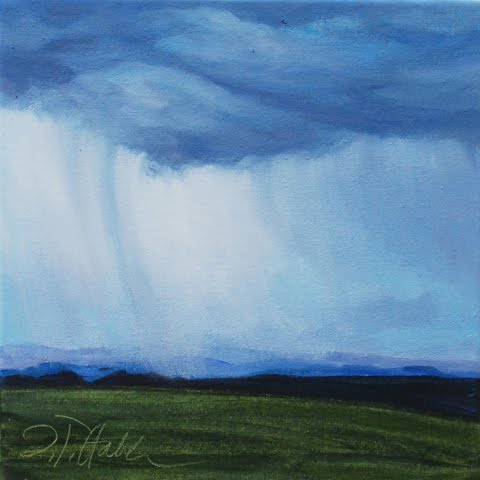
It feels so good being in a dry place and watching the rain coming down in sheets!
Even though I painted this piece in my studio and from a photograph, it was more like doing a plein air painting, because I have seen and painted such scenes on location so many times. Just this time I didn´t have to pack up in a hurry and run!
"Rain" is part of my skies series.

Rain

Rain is a fascinating topic.
"Night Rain" belongs to my skies series, even though more than half of it´s space is filled with solid matter. The rain cannot be seen, but felt. It is pitch black night and the moisture in the air refracts every droplet where it meets a street light, the asphalt is glistening in front of car´s headlights and contours get blurred by the blinding play of dark and light.
Just as we move fast in the rain, trying to get home dry and safe, merely paying attention to what´s most important, I painted this picture very quickly, with as little detail as possible.

Thursday, September 23, 2010

Teaching Realism


There are many degrees of realism in art, from almost photographic depictions to very simplified, abstracted, but still recognizable interpretations.

Most of my students know my work before they take my classes, so they expect to be taught how to paint in a more or less realistic style.
However, style cannot be taught, it has to be conquered by years of work.
What I teach is how to get there:
First, an understanding of color and its three properties: Hue, Value and Chroma, and second, how to truely see and observe: How to use what the right brain senses and what our eyes see, to create on the canvas, through a pattern of shapes and colors, the image exactly the way we want it to look.
Knowing or seeing every detail of the subject is not only unnecessary for the painter, but often undesirable. The left, logical side of the brain interferes in such a way that it blocks the right side, which is more creative. What we know (or think we know) gets in the way of real observation and without real observation there is no true realism.

Sunday, September 5, 2010

Revolution and Independence


2010 is the year in which Mexico celebrates 200 years of its Independence form Spain and 100 years since the Revolution.
A lot has changed for the average Mexican citizen in this last century, but less for the indigenous population.
Which may turn out to be good.
The question arises: How much change is desirable, how much modernization can be called progress before it becomes the beginning of the end for the indigenous cultures?
Mexico would not be what it is today if it were not for its history, rich in prehispanic cultures. Mexico must be reminded that it should be proud not only of the temples and pyramids these ancient inhabitants left, but also of the fact, that their descendants are still alive in the indigenous polulation of today. Their old ways of producing arts and crafts are valuable skills to be preserved and, in the long run, this may be more important to the tourism industry of this nation than building more and more developments and golf courses at the beaches, in places where there is no sustainable source of water and where natural eco systems, like mangroves, have to be destroyed to make room for the so called progress.

Friday, August 20, 2010

Water

I love to go plein air painting in Mexico in the rainy season.
Often, the mornings are sunny and very bright, the rains come in the afternoon or evening.
The water refreshes the colors of the land, the sky, the trees. It fills the lakes, charges the air with negative ions and adorns the sky with beautiful clouds.

Sunday, June 13, 2010

Morning Light


Early next morning we painted the same mountains from a different vantage point.
The sun was strong already, however, even though the field in the foreground is yellow, a warm tone, all colors, especially the sky and the mountains in the distance looked much cooler than the day before.

Sun gets filtered by the atmoshere it travels through, and early morning moisture in the air accounts for the fact that some of the rays get reflected before they can reach our eyes.

Afternoon Light

I love the hues the sun creates on the landscape during late afternoon hours.

Longer shadows mean more excitement in a painting, as cool shadow colors contrast with those where the heat is still lingering in the the sun drenched landscape.

This scene is in the mountainous region of Mascota, not far form Puerto Vallarta, in western, central Mexico. There are volcanos everywhere.
My painting buddy and I had been searching for a good spot to capture the warm afternoon glow on the mountains, driving up and down a little dirt road, when we happened upon this place. Almost as soon as we had set up, cattle come around the corner, right at us, and they probably wondered what we were doing there. They left soon, of course, but not before we got a few snapshots for future studio paintings.

Tuesday, November 24, 2009

Thanksgiving


And again, it´s time to think about turkeys and pumpkins!
A year ago, during a non-painting-trip to Austria, I saw a field full of pumpkins, ready to be harvested. It looked very pretty and I took some photographs. A week later, quite a few pumpkins remained in the field when early snow surprised the place. Now the view was even more stunning. The sun had melted the snow away on the south side to reveal bright orange dots, randomly strewn over the field.
With winter approaching, it felt like the right time to paint the scene now!

Saturday, November 21, 2009

The Right Brain and Plein Air Painting

As studies have shown, when we give our right brain hemisphere a chance of being active, life is more enjoyable, we become more open minded, creative, at peace, and we experience ouselves as being less judgemental, less critical and less frustrated.
There is no doubt in my mind that plein air painting is a good way of activating one´s right brain. Being exposed to all the sensory stimulations, the beauty of the view, the atmospheric properties of each scene, like sun, wind, rain or fog, sometimes a fragrance, the soft noises of nature, all that gives the artist the opportunity to become part of the landscape, to really understand it´s essence.
In such a state of mind, painting what you see becomes spontaneous and exhilarating and, unlike with studio painting, the memories of each individual experience are going to stay with you.

Friday, November 13, 2009

Atmosphere


At the end of the rainy season in central Mexico, wildflowers appear just about everywhere. This landscape is in Jalisco, near a quaint little town, called Tapalpa.
Moisture still hangs in the air after one of the last downpours in October, but the sun is coming through to illuminate patches of flowers and the vibrant green of the high grasses.
I have painted years ago in almost the same spot, but every season the flowers form other color patterns and, depending on the atmospheric condition, everything looks different every day.

Tuesday, September 15, 2009

Quick Oil Sketches

A San Diego art group invited me
to participate in a session
of figure painting. I accepted, of course, as the human figure has always been one of my favorite topics.

The model posed with her dog and we had about an hour and a half to paint. The experience was a bit of a challenge, since the pooch sat down differently after every break, but I have often considered challenges to be an artist's best friend.
Try limiting your time, reduce the assortment of colors on your palette to the bare minimum, choose an unfamiliar size of canvas, or a model in movement and you will see that, in response to these "obstacles", your attention will be more focused and your concentration heightened.

As far as time constraints are concerned, I feel that a quick, sketchy color note can say more than a perfectly rendered painting.

Saturday, August 22, 2009

Beach Paintings


I love to watch - and of course to paint the waves rolling in at the beach. There is something reassuringly artistic about the fact that such a repetitive action can happen without it's outcome ever looking quite the same.
Not long ago I walked on a beach of the Pacific Ocean, at the Nayarit village of San Pancho in Mexico. A woman of the Huichol tribe, dressed in her brightly colored traditional outfit, was sitting on a pile of sand, looking at the sea. Maybe she was pondering the same thing while her daughter played with a dog nearby.